Swimming with turtles at Kizimkazi: what you are actually booking
Updated September 24, 2026 · 6 min read
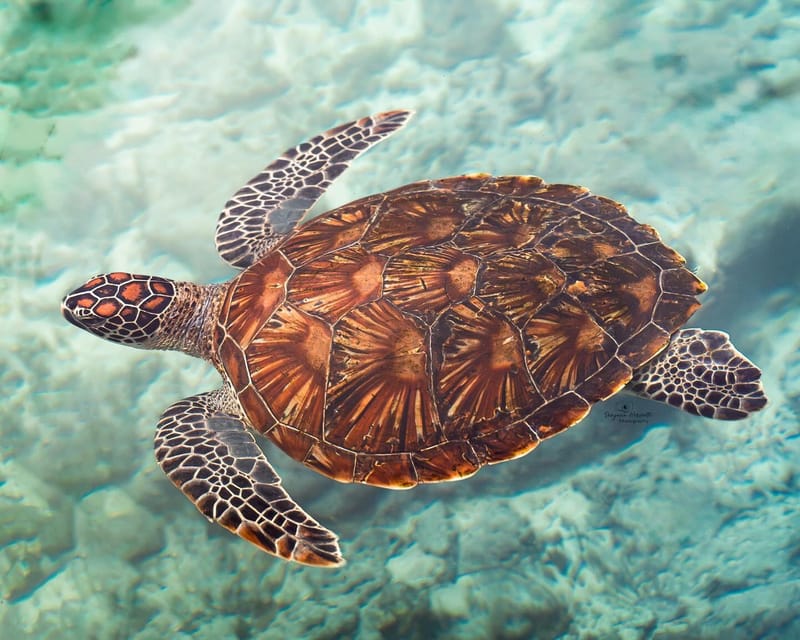
There are 41 offers in the current stock with turtles in the title, from €16.69. Twenty-two of them are at Salaam Cave in Kizimkazi, from €22.93. Three are at Nungwi.
Those are not variations on one experience. They are two different kinds of place sold under the same five words, and the listings are more honest about the difference than most visitors notice.
What Salaam Cave actually is
Kizimkazi Dimbani sits at the far southern tip of Unguja. Salaam Cave is a limestone pool there – clear, sheltered, surrounded by coral rock and trees, and enclosed.
The turtles in it live in it. The most-reviewed of those 41 turtle offers, at 412 reviews, describes the place in its own words as one that “houses and cares for” sea turtles, and its list of what is included in the price runs: hotel pickup and drop-off, entrance fees, professional driver, and “sea weed for the turtles feeding”. Another listing in the same stock is titled “Salaam Cave Play, Feeding, Swimming with Freandly Sea Turtle” – operator’s spelling and all. A third calls the place an aquarium in its title.
None of that is hidden. It is on the booking page, in the inclusions, in the title. But “swim with sea turtles in Zanzibar” reads to most people as an encounter with wild animals in the sea, and this is not that. It is a swim in a pool with animals that are kept there and fed by visitors, and the feed is a line item in the price.
Both species you might see are in trouble in the wild – the green turtle is listed as Endangered on the IUCN Red List and the hawksbill as Critically Endangered – which is precisely why it is worth knowing which kind of place your money is going to.
The three places, and why they get confused
Salaam Cave, Kizimkazi. The pool described above. Twenty-two offers in the stock, from €22.93, almost all of them with hotel pickup because of how far away it is.
Mnarani Marine Turtles Conservation Pond, Nungwi. Founded in 1993 by the local community and run as a non-profit, it describes its model as rescue, rehabilitation and release, with an annual release day on 20 February. That is a different proposition from the pool at Kizimkazi, and it is the one to look for if supporting turtle conservation is the reason you are going.
Baraka Natural Aquarium, Nungwi. A few minutes’ walk from Mnarani and easy to mistake for it. It lets visitors into the water with the turtles. Reviewers there have repeatedly raised welfare concerns – the number of people allowed in the pool at once, animals being stepped on, and questions about diet and whether anything is released.
Three of those 41 offers name Nungwi or the aquarium in their title against twenty-two for Kizimkazi. The market is selling the swim, not the sanctuary, and if you want the sanctuary you will have to go looking for it rather than scrolling.
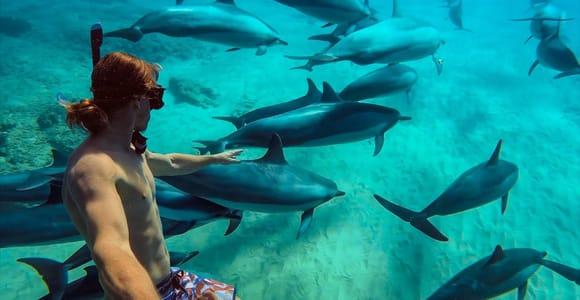
The turtle swims sit under swim with dolphins and turtles – 90 offers from €14.41.
Three questions worth asking before you pay
None of these are confrontational, and any decent operator will answer them.
- Does this facility release animals, and when was the last release? A rehabilitation pond can name a date. A permanent collection cannot.
- How many people are in the water at one time? This is the single thing that separates a calm encounter from the crowding reviewers describe.
- Am I expected to feed them? You often do not need to ask – if the inclusions list seaweed, that is the answer.
And one thing not to do, wherever you end up: do not sit on, ride or hold a turtle for a photograph, whatever anyone around you is doing.
If you want wild turtles, you snorkel
The honest alternative is the reef. Green and hawksbill turtles live on Zanzibar’s reefs and are seen by snorkellers and divers, with no enclosure and no guarantee – which is the trade you make for a wild animal. The reef trips off the north-east coast are the realistic place to look: snorkelling at Mnemba, and the wider snorkelling category runs to 88 offers from €10.
A sighting is luck. A pool is a certainty. Which of those you want is the actual decision here, and it is worth making deliberately rather than discovering at the water’s edge.
Getting to Kizimkazi – and whether you need a car
This is the far south. Reckon on about an hour and a half from Stone Town and considerably more from the northern beaches, on roads that get narrower the further down you go. It is why almost every Kizimkazi listing includes hotel pickup, and why the ones that do not are cheaper for a reason.
For this particular day, take the transfer. Driving yourself to Kizimkazi and back is a long way to go for an hour in a pool, and self-driving on Zanzibar has a paperwork step that catches people out.
Traffic runs on the left. The Zanzibar Revenue Authority issues its own local driving permit and publishes the rates for exchanging a foreign or international licence for one – from TZS 40,000 for a year, for holders of a licence from a country party to the 1949 or 1968 Road Traffic Conventions. The island’s hire companies state uniformly that this local permit is required in addition to your own licence and will arrange it for a fee; the revenue authority’s own page sets out the exchange but does not spell out the obligation, so confirm it with the hire company in writing before you count on driving.
If a car makes sense for your trip as a whole – the east coast villages, the spice farms, moving between beaches – rather than for this one excursion, it is worth comparing hire cars for Zanzibar before you arrive, when the choice is wider. For a single trip to Kizimkazi it is the wrong tool.
What it is usually bundled with
Kizimkazi is far enough that it is almost never sold alone. The standard combination is Jozani Forest in the morning and the cave after, sometimes with lunch at The Rock, and it is a sensible pairing because both are on the same road south.
Be clear with yourself about which half is which, though. Jozani is a national park with a wild, endemic animal in it; Salaam Cave is an enclosure. Booking them together is fine. Confusing them is the thing to avoid – Jozani Forest and the red colobus sets out what the park half gives you.
How the south of the island fits with the rest is in what to see in Zanzibar.