Jozani Forest and the red colobus: the only place on earth
Updated September 24, 2026 · 6 min read
Most of what Zanzibar sells you exists elsewhere in better form. The beaches have rivals across the Indian Ocean, the spice farms have equivalents in Kerala and Grenada, and a mainland game drive is something you could do from a dozen other airports.
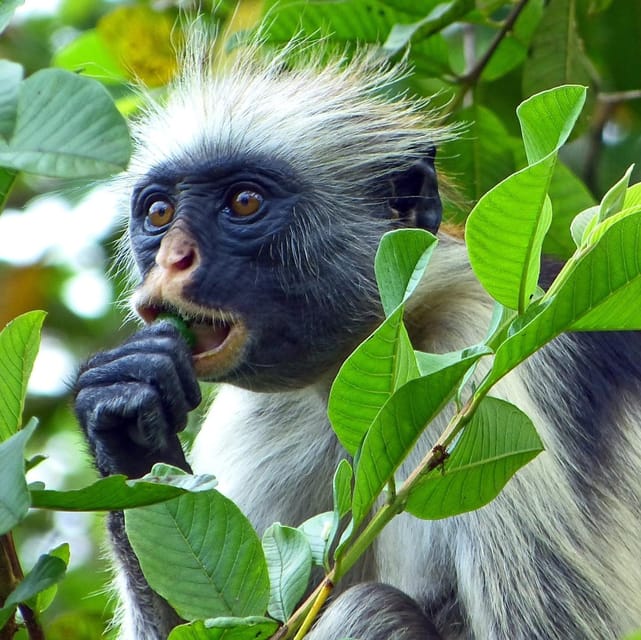
Jozani is the exception. The Zanzibar red colobus (Piliocolobus kirkii) lives on Unguja, on the small islands of Uzi and Vundwe, and on no other land on earth. It is listed as Endangered on the IUCN Red List, and the most complete census published to date, in the conservation journal Oryx, counted just over 5,800 animals. Roughly half of them are in and around this one park.
So this is a ninety-minute walk to see something genuinely irreplaceable, about 35 km south-east of Stone Town, and it costs a fraction of anything else on the island’s wildlife menu.
What you actually see, and how close
The park is Zanzibar’s only national park, and the colobus troops near the main entrance are habituated – not tame, not fed, but used to people standing four or five metres away photographing them. You will see them. This is not a probability-based outing like a dolphin trip or a game drive; the animals are in known trees along a known trail, and guides know which troop is where that morning.
They are worth looking at properly rather than just photographing. The red-brown back and the black shoulders are the obvious part. The less obvious part is that they are leaf-eaters with a chambered gut, which is why they spend most of the day sitting still and digesting, and why a troop looks so much less busy than the vervets and Sykes’ monkeys you will also pass. If a listing calls them “golden monkeys” – and one in the current stock does – that is simply the wrong animal. Golden monkeys live in the Virunga volcanoes, a continent’s width away.
The second half of the ticket is the mangrove boardwalk, on the other side of the road. It is usually the quieter half and often the better one: a raised walk through saltwater forest, crabs, mudskippers, and an explanation of why the whole eastern side of this island is built on coral and holds no fresh water at the surface. Groups that skip it are usually groups on a tight combination schedule.
Plan around ninety minutes for the forest trail and another thirty to forty for the boardwalk. Early morning is cooler, and the monkeys move more before the heat.
The speed bumps, and why a guide will point them out
There is a public road running straight through the park, and it is the single biggest threat to the animals you came to see.
Researchers recorded mammal roadkill along that road for four years, from January 2016 to December 2019, and published the result in Oryx. The red colobus was the most frequently recorded species: 29 of 53 documented deaths, roughly one animal every six weeks. Before four speed bumps and colobus-crossing warning signs were installed near the main entrance, a colobus was reportedly being killed every two to three weeks – an annual mortality the researchers put at roughly 12 to 17 per cent of the local population. The study puts no percentage on the reduction itself; it sets the two rates side by side.
That is an unusually clean conservation story – a cheap, physical, boring intervention that measurably worked – and it is worth knowing while you are standing there, because it changes how the place reads. The park is not a wilderness. It is a remnant with a road through it, held together by speed bumps and a gate.
It also means something practical: if you are being driven to Jozani, the person at the wheel slowing down for the bumps is not wasting your time.
The entrance-fee trap
This is where the listings get slippery, and it is worth two minutes before you book.
There are 48 offers in the current stock with Jozani in the title. Exactly one of them states in its title that entrance fees are included. The rest may or may not include them, and the difference is paid at the gate, in cash, by you.
The spread tells the same story. The cheapest Jozani-titled offers start at €15.02 – and that one is a three-hour trip that gives you the spice farm, Stone Town or Jozani, not all three. A standalone three-hour forest tour sits around €22.14. The combination days that bundle the spice farm, the forest and a cave start at €43.92, with the middle one at €51.83 and no ceiling above that. And the most reviewed one, at 414 reviews and 4.8 stars, is €70.27 – its title spells out both hotel pickup and entry fees, which is exactly why it can charge that.
So compare inclusions, not headline prices. A €22 tour plus gate fees plus a taxi from the east coast is not cheaper than a €70 tour with pickup and fees folded in; it is the same day with more cash changing hands and more that can go wrong.
There are 92 nature and forest offers from €15.02 at nature and Jozani Forest.
What it is usually bundled with, and whether that is good
Jozani sits on the road south, which is why it is almost never sold alone. The three standard companions:
A spice farm. Genuinely on the way, genuinely worth an hour, and home to the cheapest offer on the whole island at 86 offers from €7.91 – spice farm tours. This is the bundle that makes sense.
Salaam or Maalum cave. Also close, and a swim in a collapsed limestone cave is a real thing to do. But some of these listings sell “swimming with sea turtles” at a cave near Kizimkazi, and that is a different proposition from wild animals in a national park – enclosed water, fed animals. Know which of the two you are buying.
Mtende or Michamvi beach. Fine, but it turns a three-hour morning into a seven-hour day, and the beach is one you could reach from your hotel anyway.
If you are choosing between Jozani and a mainland game drive, the honest comparison is in safari from Zanzibar: the safari is a better wildlife day and costs ten to twenty times as much. Jozani is the better value and the only one of the two you cannot do anywhere else.
Practical points
Closed shoes rather than sandals – the trail is root-crossed and the boardwalk gets slick. Long sleeves if you react to mosquitoes; this is standing water and shade. No flash, and no feeding, which is the rule everywhere and matters here because roughly half the species is in this one forest.
On what the park can do for visitors with limited mobility, the boardwalk is level and raised while the forest trail is not, but the park’s own current arrangements are the only reliable source – ask your operator to confirm with the gate before you book rather than trusting a listing.
How Jozani fits into the rest of the island, and how far it is from wherever you are staying, is in what to see in Zanzibar.