Stone Town on foot: what a guide adds, and what is closed
Updated September 24, 2026 · 6 min read
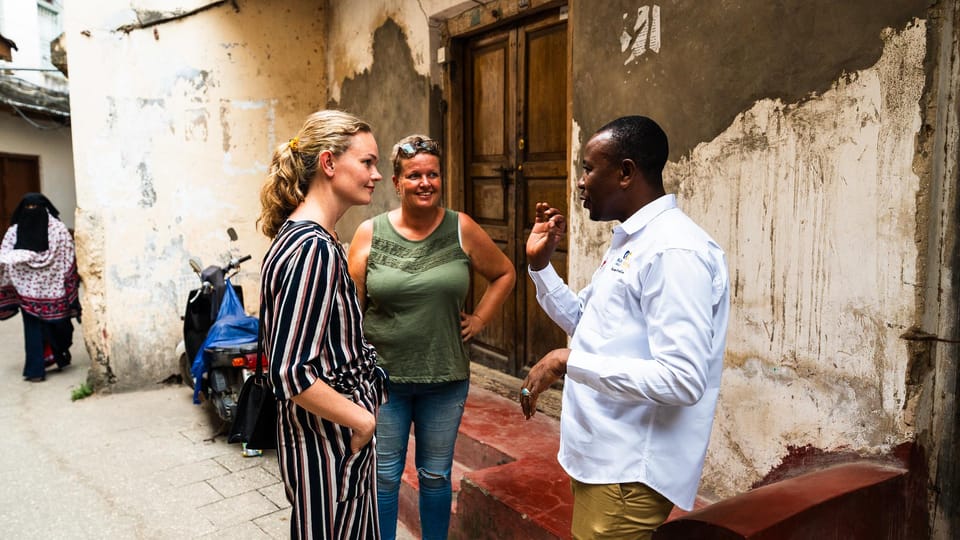
Stone Town can be crossed on foot in twenty minutes. Nobody manages it. The alleys were laid out for people and handcarts, they bend, they end in courtyards, and there is no grid underneath to fall back on. That is the whole appeal, and it is also the argument for a guide – not because you would get lost for long, but because without one you walk past almost everything.
What UNESCO actually inscribed
The site is on the World Heritage list as the Stone Town of Zanzibar, and the official description is worth reading before you go, because it names what to look at. UNESCO calls it an outstanding example of a Swahili trading town, its fabric and townscape essentially intact, built of coralline ragstone and mangrove timber, with elaborately carved double “Zanzibar” doors and decorated interiors – African, Arab, Indian and European building traditions layered over more than a millennium.
It was inscribed under three criteria: for that fusion of cultures, for the seaborne trade between Asia and Africa that produced it, and – the third one people rarely mention – for its symbolic importance in the suppression of slavery.
The buildings UNESCO names include the Old Fort, the House of Wonders, the Old Dispensary, St Joseph’s Roman Catholic Cathedral, Christ Church Anglican Cathedral, the residence of the slave trader Tippu Tip, and the Persian baths. That list is a better route plan than most tour descriptions.
The former slave market, which is the reason to come
Christ Church Anglican Cathedral stands on the ground where Zanzibar’s largest slave market, at Mkunazini, used to operate. That is not a coincidence or a later reinterpretation – the church was deliberately built there to mark the end of the trade. Construction began on Christmas Day 1873, the year Sultan Barghash signed the abolition treaty that shut the market down, and the building was finished in December 1880. It was consecrated in 1903. The altar is said to stand where the market’s main whipping post stood.
Underneath, holding chambers have been preserved. They are low, dark and very small, and you go down into them. There is no interpretation panel that prepares you for the ceiling height. This is the part of Stone Town that people remember years later, and it is the reason the third UNESCO criterion exists.
A guide matters more here than anywhere else in town, because the site is physically unremarkable and the meaning is entirely in what happened on it. Several listings name the slave market explicitly in the title – one combines it with the spice market – and those are the ones to look for.
The building you cannot see
The House of Wonders (Beit-el-Ajaib) is the tall, many-balconied palace on the seafront that appears on essentially every image of Zanzibar. It partially collapsed on 25 December 2020. The clock tower came down and two people who were inside were killed. It has been closed to the public ever since, and there is no confirmed reopening date; restoration has been pledged and repeatedly discussed without the building opening.
Any tour that lists the House of Wonders as something you will visit is describing an exterior behind hoarding. That is not necessarily a bad stop – it is still the most striking façade on the waterfront, and the collapse is now part of the town’s story – but it should be sold to you as what it is.
What three hours gets you
The most reviewed walking tour in the current stock is a three-hour private walk with a guide, at €18.45 with 413 reviews at 4.6 stars. That is the shape most people want, and three hours is genuinely the right length: enough for the cathedral and the chambers, Darajani market, the fort, the seafront and a run of alleys, and short enough that you are not in the heat at its worst.
Some things a good walk will time for you rather than just show you:
- Darajani market is a morning place. Go when the fish and produce arrive and it is a working market; go at three in the afternoon and it is a smell.
- Forodhani Gardens on the seafront is the opposite – it is nothing during the day and becomes a food market at dusk. Most walks end near it for exactly that reason.
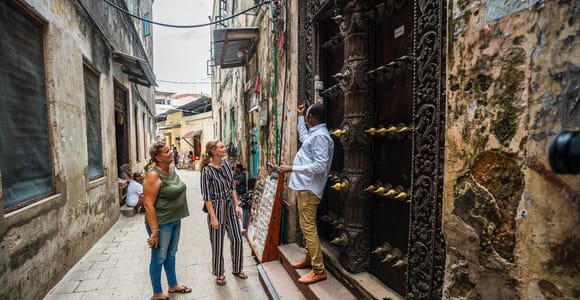
- The doors. Indian-influenced doors have rounded, ornamented frames; the Omani-influenced ones are rectangular with brass studs. Once someone points the difference out you will see it on every street, and it is the single most useful thing a guide hands you.
There are 147 Stone Town offers from €9.66 at Stone Town tours. The cheap end is generally a shared group walk, but private does not mean dear here: the median private listing is €29.23 against €48.31 for the rest, and the most-reviewed private walk is €18.45, among the cheapest of the lot. Private is worth it in a town where the guide’s voice competes with traffic – and it costs you nothing extra. There is also at least one private tour in the stock with a French-speaking live guide, which is easy to miss if you only read the English titles.
Two things that catch visitors out
The dress rule is not merely advisory. The UK government’s travel advice for Tanzania states that women wearing shorts or sleeveless tops away from tourist resorts in Zanzibar and Pemba – particularly in Stone Town – may cause offence, and that the authorities can impose fines exceeding $700 for what they class as inappropriate clothing. Nobody is going to stop you for bare shoulders on the seafront. But Stone Town is a working, predominantly Muslim town and not a resort strip, and covered shoulders and knees are both the respectful choice and the prudent one. Take something light with long sleeves; you will also want it in the cathedral.
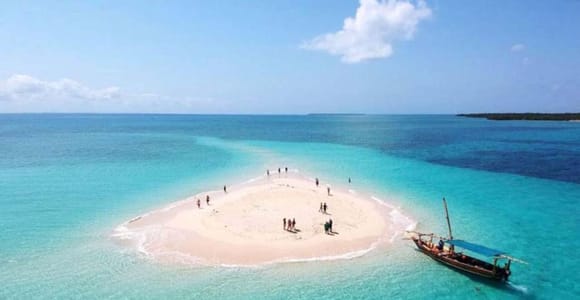
Stone Town is not where the beach is. Basing yourself here puts you close to the ferry, the market, the restaurants and the departure point for the island tours – 137 offers from €10, the Prison Island and Nakupenda sandbank trips leave from right here. It also means that the swimming is poor and the nearest good sand is a drive away. Most people stay on the coast and come in for a day, which works, but it turns three hours of walking into a ten-hour day with two hours of road in it. If that is your plan, pair it with something else in town rather than going back and forth twice.
The spice farms lie on the road between here and the south of the island, which is why almost every combination ticket includes one – 86 offers from €7.91 at spice farm tours. How the rest of the island fits around this town is in what to see in Zanzibar.